
Key takeaways
- Read the notice and confirm the violation record before authorizing work.
- Separate the physical correction from the DOB, inspection, hearing, and closeout records.
- Use a Licensed Master Plumber when the cited condition requires plumbing permits or licensed supervision.
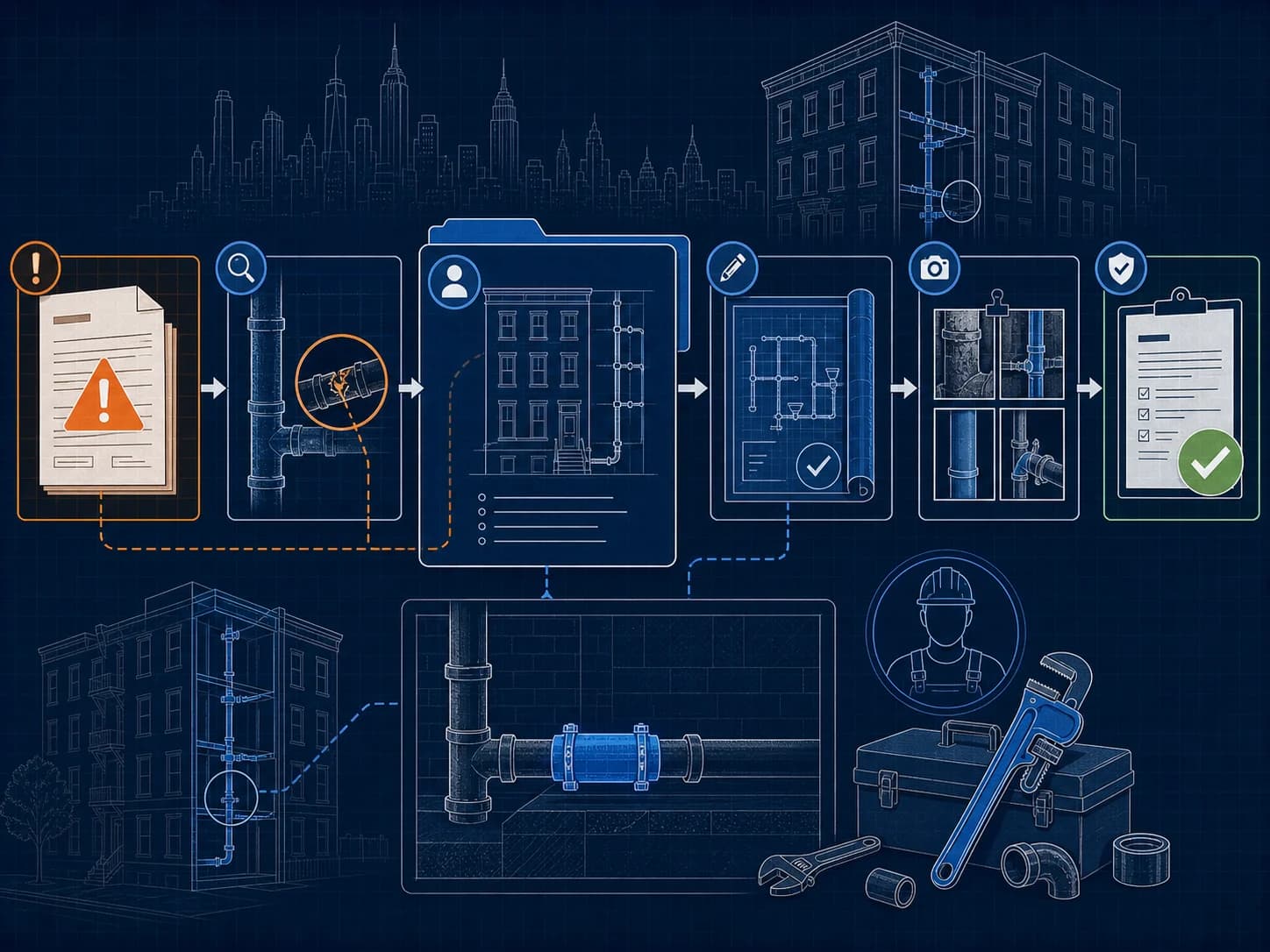
A step-by-step guide for property owners, from the moment the notice arrives through correction and agency closeout.
A Department of Buildings violation taped to your door or sitting in your mailbox needs prompt review. Early record checks help owners preserve hearing, correction, filing, and closeout options shown on the notice.
This guide explains how to read the violation notice and when to bring in a Licensed Master Plumber to address the field condition and DOB record.
Why Plumbing Violations Happen
The NYC Department of Buildings issues violations when a property's plumbing work or conditions fall outside the requirements of the NYC Plumbing Code. Common triggers include:
- Work performed without a required permit. A plumbing or gas alteration that required DOB filing but was performed outside that permit path can create a work-without-permit violation.
- Failed inspections. If a scheduled DOB inspection reveals work that doesn't meet code, the inspector can issue a violation on the spot.
- Complaint-driven inspections. A neighbor, tenant, or city agency files a complaint. DOB sends an inspector. If conditions don't pass muster, a Notice of Violation follows.
- Periodic inspection or filing non-compliance. Local Law 152, boiler, and other compliance records can create their own DOB notices or violations. DEP backflow records follow a separate agency path.
- Illegal connections or cross-connections. Drain lines tied into the storm sewer, potable water lines without proper backflow protection, or unapproved gas piping configurations are all red flags.
Understanding why the violation was issued is the first step toward resolving it efficiently.
Step 1: Don't Panic - But Don't Wait
When a notice arrives, read the date, classification, cited condition, hearing information, and any correction instructions immediately. The applicable response or correction date comes from that record; do not substitute a generic countdown.
In the first 24 hours, do three things:
- Read the violation carefully. Identify the violation number, the class, the code section cited, and the correction deadline.
- Match it to the public record. Search DOB NOW's public Violations & Notices of Deficiency portal and BIS where the older record is maintained. Confirm the number, address, status, and related summons rather than relying on a paper copy alone.
- Identify the required professional. Bring in a Licensed Master Plumber when the correction involves permit-required plumbing or gas work. Administrative records and Certificate of Correction roles vary, so the notice—not the word “plumbing” by itself—determines who must submit and attest.
Step 2: Separate the DOB Violation From Any OATH Summons
A DOB violation and an OATH summons are related records, but they are not interchangeable. DOB’s violation guidance explains that the violation remains open until the condition and required closeout are accepted. An accompanying OATH summons has its own hearing, cure, and penalty information.
Use the actual notice—not a generic online fine table—to identify:
- The violation type and cited condition.
- Whether the condition is described as immediately hazardous.
- Any cure date, hearing date, or response instructions.
- The infraction code and penalty schedule that apply to that specific summons.
- Whether DOB requires a Certificate of Correction, inspection, permit sign-off, or another closeout.
If the notice describes an unsafe gas, fire, sewage, or structural condition, follow its emergency instructions first. For all other cases, confirm the record before assuming a standard deadline or penalty applies.
Step 3: How to Read the Violation Notice
A DOB Notice of Violation packs a lot of information into a single page. Here's what to focus on:
| Field | What it tells you |
|---|---|
| Violation or summons number | The tracking number used to find the official record. |
| Issuing agency | Whether DOB, HPD, DEP, OATH, or another authority controls the next step. |
| Infraction or code section | The rule and penalty schedule tied to the cited condition. |
| Description | What the inspector says existed at the property. |
| Respondent | The person or entity named on the notice. |
| Cure or correction information | Whether the specific notice offers a cure path and what proof is required. |
| Hearing date | The response date for an accompanying OATH summons, if one exists. |
Pay special attention to the cited condition and infraction code. Those fields—not the short database summary—determine the correction scope and the documentation DOB or OATH will review.
Step 4: Get a Master Plumber Review
If the correction involves work that must be permitted or supervised by a Licensed Master Plumber, bring the LMP in before anyone changes the field condition. Some records are administrative; others require licensed plumbing, gas, boiler, water-service, or sewer work. The notice and actual scope determine which path applies.
What a Master Plumber Review Includes
- Site inspection. The plumber visits the property, reviews the physical conditions, and compares what's on the ground to what the violation describes.
- Code analysis. The LMP reads the cited code section and determines the scope of corrective work required to bring the condition into compliance.
- Correction plan. You get a clear explanation of what needs to be fixed, what permits may need to be pulled, and a realistic timeline.
- Permit filing. If the violation involves unpermitted work, the LMP can file the required plumbing permits through DOB NOW.
- Corrective work. The physical repairs, replacements, or modifications are performed.
- Correction documentation. The LMP supplies the licensed-trade records within its scope. DOB's current COC workflow separately identifies the submitter, certifier, corrector, and owner/respondent attestation roles.
When to Move Directly Into a Master Plumber Review
- The notice describes an immediately hazardous condition. Follow the safety and correction instructions without delay.
- You're unsure what the violation means. A plumber who works with DOB regularly can translate the code citation into plain English.
- The violation involves gas piping. Gas violations carry elevated risk and often trigger additional Local Law 152 requirements.
- Multiple violations are listed. A professional can prioritize and sequence the corrections.
- You've already received an OATH summons. Coordinate the physical correction and the OATH/DOB response dates without assuming one record resolves the other.
Step 5: File the Certification of Correction
For a DOB-issued OATH summons that uses the Certificate of Correction process, field work alone does not resolve the DOB record. DOB says an approved COC resolves the summons; a disapproved request can be resubmitted or disputed. A summons dismissed at an OATH hearing follows that separate disposition.
- Use the required DOB submission path. Follow the current instructions on DOB’s Certificate of Correction page.
- Submit the evidence required for that violation. This may include sworn statements, photographs, permits, inspection results, penalty records, and licensed-trade documents.
- Track the submission. A submitted package is not the same as an accepted correction.
- Recheck the public record. Confirm that DOB shows the expected disposition before treating the matter as closed.
What Happens If You Don't Act
Ignoring a DOB violation does not close the public record and can narrow the owner’s response options.
- An accompanying OATH summons can proceed to a hearing or default if it is not answered.
- Penalties depend on the cited infraction, hearing result, correction status, and applicable schedule.
- The violation can remain active on the public property profile until it is dismissed at OATH or resolved through DOB's COC process.
- An open record can affect later due diligence or project closeout, depending on the parties and scope.
- A continuing hazardous or unpermitted condition can lead to additional enforcement; the consequence comes from the condition and governing rules, not simply the age of the record.
The practical goal is to address the safety or service condition while keeping the DOB and OATH records on the same closeout path.
Common NYC Plumbing Violations and What They Mean
Work without a permit: Plumbing or gas work that required DOB filing was performed outside that permit path.
Illegal drain or sewer connection: The cited drain, waste, or sewer connection does not comply with the applicable approved scope or code. Read the exact violation before deciding which DOB or DEP correction path applies.
Backflow preventer non-compliance: Installed backflow prevention devices can carry recurring DEP testing and documentation requirements. Confirm the device record and current DEP instructions.
Gas piping inspection failure: Buildings covered by Local Law 152 follow a recurring community- district inspection cycle. Confirm covered status and the current schedule on DOB’s official page.
Cross-connection: A physical link between a potable water supply and a non-potable source without proper backflow protection.
Related next steps
- Review Austin’s full DOB plumbing violation removal process.
- Use the Certificate of Correction guide when the field work is complete but the record remains open.
- Read the OATH/ECB hearing guide when the notice includes a summons or hearing date.
Common Questions
What should an owner check first after receiving a DOB plumbing violation?
Confirm the issuing agency, violation number, cited condition, classification, hearing or cure information, and the matching BIS or DOB NOW record before deciding on repairs or filings.
Does fixing the plumbing automatically close the DOB violation?
No. Physical correction and agency closeout are separate steps. The record may also require permits, inspection sign-off, a Certificate of Correction, or an OATH response.
When does a DOB plumbing violation need a Licensed Master Plumber?
Use a Licensed Master Plumber when the condition involves plumbing permits, gas piping, boiler work, or other work that NYC requires to be filed or supervised under an LMP license.