Key takeaways
- Treat a gas shutoff as a safety event and follow the utility’s instructions.
- Identify whether the condition also created DOB violations, permits, or inspection requirements.
- Restoration requires the utility’s authorization after the required correction and documentation steps.
A gas shutoff can interrupt cooking, hot water, heat, or individual equipment depending on which service was isolated. It also creates a utility-controlled restoration process.
Restoration is controlled by the utility and depends on the scope of the shutoff. The correction may require a Licensed Master Plumber, pressure testing, DOB filings or inspections, and utility authorization. Start with the shutoff notice rather than assuming every building follows the same sequence.
If you smell gas right now, follow your utility’s emergency instructions. Con Edison tells customers to leave immediately and call 911 or its gas emergency line from a safe location; see Con Edison gas safety. Everything below is for after the immediate danger is handled.
Why Gas Gets Shut Off in NYC Buildings
Utilities may shut off gas when they identify — or are notified of — an unsafe condition. Common records owners encounter include:
An unsafe condition found during a Local Law 152 inspection. DOB's gas piping inspection guidance distinguishes conditions that require immediate utility notification from conditions handled through the certification and correction process.
A leak or odor call. A tenant reports a gas odor, the utility or FDNY responds, and a leak survey confirms a problem. Service is cut at the meter or at the curb, depending on where the leak sits.
A red-tagged boiler. The utility identifies an unsafe condition at the boiler or its gas connection and suspends service to that equipment. No heat and no hot water from that boiler until the tag is cleared.
Illegal or unpermitted gas piping discovered during other work. A renovation opens a wall, an inspector sees piping that was never permitted, and the entire line is shut down pending legalization.
Meter tampering or unauthorized connections. The most serious category — these shutoffs come with enforcement attention on top of the restoration work.
The First 24 Hours: What Building Owners Should Do
- Get the paperwork from the utility. The shutoff notice or red tag states the reason for the suspension. That document defines the scope of what has to be corrected — keep it, photograph it, and have it ready for the plumber.
- Do not attempt to restore service yourself. Follow the utility notice and have the required licensed professionals coordinate correction and authorization.
- Call a Licensed Master Plumber — not a general contractor. Gas work in NYC must be performed and filed by an LMP. A contractor without the license cannot file the permits, cannot perform the pressure test the utility requires, and cannot sign the certifications that get service restored.
- Notify tenants in writing and document the timeline. In multifamily buildings, a gas outage triggers HPD obligations around essential services. A documented record showing when the shutoff occurred and what steps you took, starting day one, matters if HPD gets involved.
- Plan essential-service communication. Coordinate lawful temporary arrangements with the building’s professionals and insurers rather than improvising fuel-burning equipment.
The Restoration Process, Step by Step
Gas restoration is a coordinated licensed-work, agency, and utility process. The exact order depends on the cited condition, but owners should treat assessment, correction, testing, required sign-off, and utility authorization as separate milestones. Austin's NYC gas piping and restoration team handles this lane from diagnosis through utility coordination.
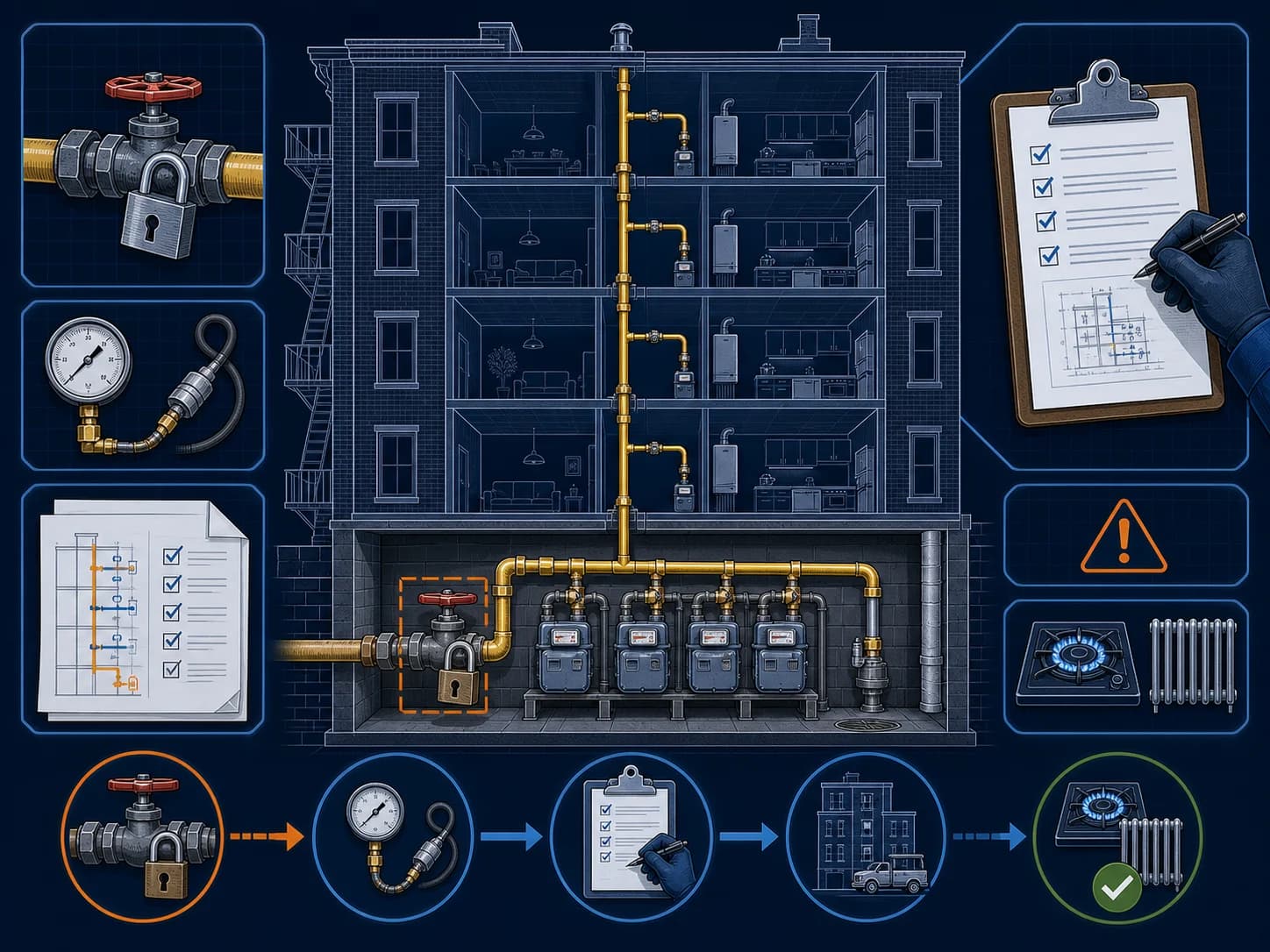
- Assessment. The LMP inspects the piping and the condition cited on the shutoff notice, determines the corrective scope, and identifies whether the work requires a DOB permit (most piping corrections do).
- Permit filing. For piping replacement, rerouting, or legalization of unpermitted work, the LMP files through DOB NOW and becomes the plumber of record. If the original condition also generated a DOB violation, the corrective filing is what eventually clears it.
- Corrective work. The physical repair — replacing failed piping, correcting illegal connections, bringing the installation up to current Fuel Gas Code.
- Pressure test. The corrected system is pressure-tested and held to demonstrate integrity. The utility requires documented passing results before it will schedule reconnection.
- Inspections and sign-off. DOB inspects permitted work; the LMP certifies completion.
- Utility coordination and restoration. The LMP coordinates with Con Edison or National Grid for the reconnection appointment. The utility verifies the test results and documentation, re-establishes service, and relights appliances.
If the test does not hold, pause this sequence and use the failed gas pressure-test owner guide to define the tested boundary, separate the inspection result from the repair scope, and track correction, retesting, DOB, and utility milestones without assuming the whole building needs the same solution.
For a record-by-record view of the handoff, use the guide to DOB gas authorization, plumbing sign-off, and utility restoration. It explains why an approved gas authorization, a signed-off plumbing record, and a utility turn-on are related but not interchangeable milestones.
For a controlled shutdown or the planning period after an emergency shutoff, use the building-wide gas-shutdown access and temporary-service guide to coordinate apartment entry, resident updates, building-specific service arrangements, and the utility restoration roster without promising a turn-on date.

How Long Does Gas Restoration Take?
There is no dependable universal duration. The condition, permit scope, tenant access, inspections, document acceptance, and utility scheduling all affect restoration. Ask the LMP to track assessment, filing, correction, testing, DOB sign-off where required, and utility authorization as separate milestones. National Grid publishes its current safety contacts and instructions on its New York gas-safety page.
When a Shutoff Becomes a Violation — and How to Clear Both
Many shutoffs arrive with paperwork attached: a DOB violation for the underlying piping condition, an LL152 deficiency report, or an OATH summons. Restoring gas and resolving an agency record are related but separate outcomes. Start with Austin's gas piping service for the licensed field and utility path; when an open DOB record also needs correction documentation, our DOB violation removal service handles that closeout. If the shutoff originated with a gas piping inspection, the Local Law 152 inspection page explains the certification and correction cycle.
Common Questions
Who can turn gas service back on after a utility shutoff?
Only the serving utility authorizes reconnection. Required repairs, permits, pressure testing, inspections, and documentation must be completed before the utility restores service.
Does a gas shutoff always create a DOB violation?
Not always, but the underlying condition may involve open violations, unpermitted work, or required DOB filings. Owners should check the utility notice and building records together.
Should an owner call the utility or a plumber first?
Follow emergency instructions on the notice. For suspected leaks, leave the area and contact 911 or the utility emergency line; licensed plumbing assessment follows once the immediate safety response is underway.